Friday, October 28, 2022


Gabriel Byrne Walking With Ghosts--Lovingly Personal Memoir

      By Joseph Cervelli

The very fine stage and film actor, Gabriel Byrne, is transfixing in his beautifully crafted and deeply personal one person show "Gabriel Byrne Walking With Ghosts" at the Music Box Theater. The Music Box is a perfect venue for a solo show--intimate enough to be enveloped into the world of the performer. 

He may be the only person on stage yet there are enough characters in his life he so tenderly and expertly conjures.  You easily envision the cast of so many which made an indelible (for better or worse) effect on his life. 

When he states he feels like "an intruder into the past" you never feel he is at all. He brings forward those he calls ghosts whom he shares with the audience. 

He starts right at the beginning discussing his parents and his early childhood in Ireland. While this might sound like you have heard stories about dealing with harsh conditions before, he has a frolicsome quality so even the difficult times become illuminating in their own way. 


He speaks of one particularly vicious teacher at the Christian Brothers school in which he being a poor math student was lashed on his hand repeatedly with a cane used for beating. Bryne vividly recreates the swishing sound. While the show utilizes sound effects this is one he wanted to relive and have the audience feel the horror of what was inflicted on him by this teacher who did not belong in a classroom.

Yet, after some troubling details along with one described and another with a classmate drowning, suddenly you hear carousel music and hanging lightbulbs suddenly appear for he is at a carnival. Like any youngster the bleak moments of a childhood can suddenly be forgotten even for a short when they find some joy and in this case by discovering the sights and sounds of a carnival. Life becomes easier. 

He was very close to his grandmother who brings him to his first movie. He recreates that scene so vividly.  Suddenly the lights  (expert lighting and effective scenic design by Sinead McKenna) dim as the MGM lion roars and he crumples up in fear. 

The show has such a universal appeal. We can all vividly remember being taken to something that thrilled us not forgetting both what it was and who took us to see it. 

Gabriel decides to join the seminary where he tells a horrific tale about being seduced by a priest.  How he handled this years later shows what a kind and compassionate man he is. Not many would have been so thoughtful. 


After leaving the seminary he becomes a dishwasher and toilet attendant before joining an amateur theater group. 

Bryne has a unique ability to go from seriousness and tragedy (his heartbreaking tale of his beloved sister is a prime example) to being frolicsome. The solemnity we have come to know in so many Irish  novels and plays is met here with the humor that he needs to get through the difficult times. He has a delightfully puckish quality that frequently appears. 

He tells a hilarious story about trying to give great depth to one line he has to say "This Way Please" in a television play. He is so thrilled given this opportunity he treats it like he was quoting a famous line from Shakespeare. Of course, it does not go over well with the director. 

The only actor (other than an aside to Al Pacino) that is mentioned is Richard Burton who was his idol. They spent a good amount of the time when not filming drinking. Byrne realized that he loved the alcohol until he correctly realizes it "betrayed" him. Sadly, the extraordinarily fine actor Burton did not and passed away at the untimely age of 58. Burton's take on fame which I read in his diaries years ago still makes quite an impact especially the way Byrne tells it. 

With Lonny Price's compassionate direction and the simply astonishing Byrne we travel with him on his emotional journey and feel honored to do so.

PHOTOS: EMILIO MADRID

Tickets are at The Music Box Theater 239 West 45th Street.


Thursday, October 20, 2022


Chester Bailey--Intriguing and Superbly Acted

     By Joseph Cervelli

Before the intriguing and exceptionally well acted (a standout performance by Ephraim Birney playing with his real life dad Reed Birney) "Chester Bailey" begins you hear the first two verses of the classic "Haunted Heart" by the popular singer of the late 30's through the 50's Jo Stafford. The memorable lyrics fit the mood of this new work by Joseph Dougherty at the Irish Repertory Theatre.

The action takes place in a hospital room in 1945 on Long Island. The always excellent set designer John Lee Beatty utilizes a turntable stage to create other locations. I especially was taken with what looks convincingly like overhead steel beams representing Penn Station. 

Ephraim Birney plays the title character, a good looking young man in his 20's, mostly in his hospital room.  Interestingly in a few scenes  you don't quite see his hands for the pajamas and robe seem a bit overlong. There is a reason for this. The other character in the play is Dr. Philip Cotton (an always perfect Reed Birney) a psychiatrist who is assigned Chester's case. 


Right from the onset you find Chester very likable young man wanting to enlist in the army during wartime. But as he tells it, his parents were very much against his serving  and his dad got him to work as a riveter in the Brooklyn Navy Yard. He was despondent when he was convinced his girlfriend dropped him only because he was not in the service. We really don't know the real reason for her breaking up with him if indeed that was. But Chester likes to convince himself so. Unfortunately, a horrific violent  incident takes place at work and the young man loses his hands, one ear and becomes totally blind something which Chester refuses to believe. This is what makes this play so compelling. How could Chester even try to live any kind of life he he refuses to believe that he is now incapable of his once normal life. He spends the time convincing the Dr. Cotton that he can see and still has hands. The young actor is amazing at the resilience he puts forward in the character. There is once scene near the end when he lets out a kind of primal scream that is heartbreakingly real. 

At the same time, Cotton has his own issues. Married with one daughter he finds out about his wife's infidelity. He also has fallen in love with the director of the hospital's wife. He wants there to be more but knows it is just an affair. He appears to be a very unhappy man and what makes him feel even worse is his inability as a doctor to convince Chester that he indeed has been severely damaged. Until that happens he cannot help him. There are various techniques he uses to convince Chester to accept his fate which don't work. 


Beautifully directed by Ron Lagomarsino he is able to show how much alike these two men are in terms of personal relationships and emotions. When the doctor makes a debatable decision at the play's conclusion, you are not sure if it is in the best interest of his patient. But certainly one that will remain with you.

Ephraim Birney is so effortless in his portrayal of this conflicted soul who  beams as he thinks about the young woman he saw working at Penn Station and then the anger when the reality of his condition is somethingwhich he will not accept.  His mood changes are so convincingly done. 


As always the very fine Reed Birney shows his emotion in a more low keyed fashion. There was one moment that was very easy to miss. He was thinking about one romantic time with his superior's wife and just has a bittersweet smile with his mouth slightly open thinking about that special time. 

This is a slow moving play but never dull with both monologues and dialogue between both characters, but the two actors make it work completely. I especially look forward to more stage roles for the younger Birney. He truly is unforgettable. 

Photos: Carol Rosegg

Tickets are available at the Irish Repertory Theatre 132 West 22nd Street. 

Thursday, October 13, 2022


 Everything's Fine--An Immensely Likable Storyteller in a Heartfelt One Person Show

      By Joseph Cervelli

I have to say that I was not that familiar with Douglas McGrath before reading in the Playbill he wrote the excellent "Checkers" several years ago and the book to the fine "Beautiful: The Carole King Musical" as well as the screenplay to the hilariously funny "Bullets Over Broadway."  I wish I had known about his adapting one of my favorite novels and films "The Age of Innocence" to the stage. Would have rushed to have seen it.

In the very pleasurable "Everything's Fine" a solo show at the DR2 Theater he acts as both writer and performer. He succeeds admirably on both levels. He is a wonderfully engaging storyteller and a kind of performer you would love to meet and ask more questions about his life. There is only one caveat in this show. While he tells loving tales of his growing up in Midland, Texas (a lot of laugh out loud humor in there) he spends a bit too much time discussing what occurs in the eighth grade. Now, in all fairness I will say I was never bored with his story about his both humorous and also troubling experience with his teacher from that grade. It does go on rather long, but I found myself laughing heartily and then at the edge of my seat thinking this is no longer a funny situation. Fortunately, nothing graphic was discussed because nothing like thankfullytook place (worth the spoiler alert to know that.) 


When McGrath discusses what he felt as a fourteen year old he captures the foibles, innocence and immaturity of a boy that age. He actually morphs into a younger version of himself. I loved his imaginary interaction with his best friend Eddie whom he mimics. Love to know what happened to Eddie. It is so believable looking for help from another fourteen year old and, of course, getting nothing but laughter. McGrath shows his kindness by forgiving his teacher despite making his life more overbearing thanany young man that age needed to contend with. Won't say anymore. You will see for yourself. 


What occurred with  his father after he met with an horrific accident as a child is told with humor and more than that warmth. There is one particular glowing moment when McGrath talks about his grandmother who read classic books to his father trying to recover from the tragedy. As the tears well up in the performer's eyes as they do when he explains how his father made one bad business decision leading to bankruptcy you might find yourself also feeling the same way. McGrath certainly has that persona. 

I can easily understand why the great actor John Lithgow would want to direct this show (first time in 45 years.) As I was watching McGrath and listening to him I could hear Lithgow's voice and even see his mannerisms. It is uncanny and probably why the result is so good. 


There is very little set (design by John Lee Beatty) except for a teacher's desk and chairs which doubles as a family dining area.

While I wished McGrath had discussed what it was like to work on both "Beautiful" and more especially "Bullets," I admired the sweetness encapsulated in his storytelling. The image of him as a child on his bike racing against blowing tumbleweed still remained in my mind well after the show. That exemplifies the enchantment of this show.

Photos: Jeremy Daniel

Tickets are available at the DR2 Theater 101 East 15th Street.


Thursday, October 6, 2022


 1776

      By Joseph Cervelli

I remember the thrill of seeing the original and exhilarating "1776." That same feeling held true when I saw the revival years later.

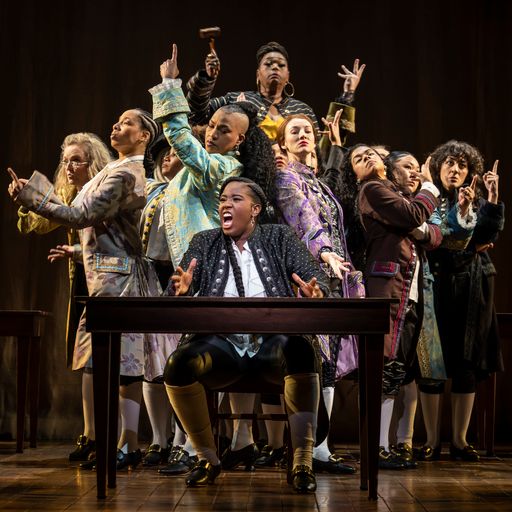
Right now a brave, new production starring female, trans and non-binary actors put a different twist on the show but remaining true to the original except for some dramatically different turns near the end. 

The superb book by Peter Stone and magnificently clever score by Sherman Edwards which tells the story about how the Second Congressional Congress bickered ferociously whether we should break away from England and declare our independence. The  idea of signing a Declaration of Independence remains still as exciting now in this new production.  

One certainly has to first compliment co-directors Jeffery L. Page  and Diane Paulus for their chance in taking such an  unorthodox approach with the cast change. When you have a great show to start with the only thing you have to make sure of is that the cast can live up to the demands. And this cast for the most part does, many of whom playing more than one role. 


First starting with a fiery John Adams (played with forceful conviction by Crystal-Lucas Perry) who never lets up on the commitment for independence. The humorous "Sit Down, John" sung by members of the  Congress along with the uniquely different but extremely effective choreography by co-director Page makes the number feel especially new. Allyson Kaye Daniel is sweetly charming as Adams devoted wife. Their duet "Till Then" still sounds as fresh as when I first heard it. 

Shawna Hamic is a hoot as Richard Henry Lee making the most in a near operatic voice of "The Lees of Old Virginia." There are some comical moments in the first act that don't always work, such as, the overdone drunken representative Stephen Hopkins (Joanna Glushak) from Rhode Island. But most of the time the directors keep them intact without going overboard. 

The always welcome Carolee Carmello is wonderfully dislikable as John Dickinson of Pennsylvania who is staunchly unpleasant in refusing to listen to reason about breaking away from England. Her rendition of "Cool, Cool Considerate Men" a memorable number from the second act is done so well with her band of supportive allies making  hem as disagreeable as they have been throughout. 

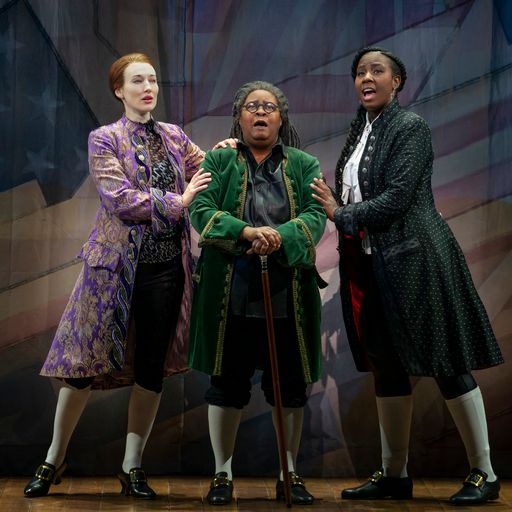
I especially enjoyed Patrena Murray who is a droll Benjamin Franklin. Murray could not have been better in portraying the jocular statesman.


The first act ends with a rousing rendition of "He Plays The Violin" sung lusciously by Eryn LeCroy who portrays Martha Jefferson. It is an affectionate ode to her husband Thomas who wooed her from the beginning of their courtship with his violin playing. The only misstep is the dour, lackluster performance of Elizabeth A. Davis as Jefferson. 

There were a few issues with the second act that mainly concerns two of the musical numbers. The strongly anti-war song "Momma, Look Sharp” is very moving number which  starts off well as sung by the courier played by Salome B. Smith. There was no need for the screeching at the end nor the ensemble to join in. The song sells itself. 

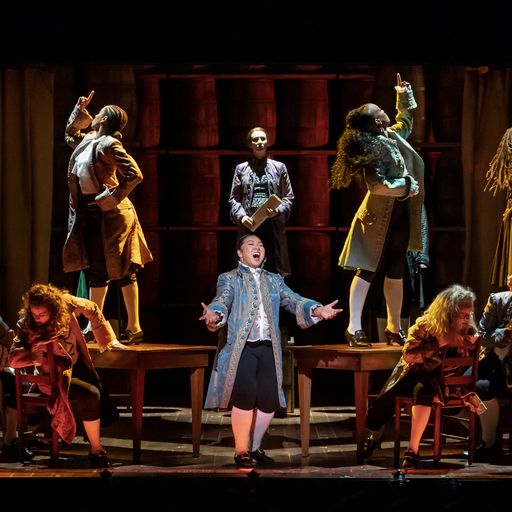
While I did like the projections of kegs in the compelling yet disturbing "Molasses to Rum"dealing with the profits from slavery, it, too, was sung with too much yelling by Sara Porkalob (Edward Rutledge). Porkalob did better in the acting role of portraying the smarmy representative from South Carolina rather than singing. Porkalob starts out so well in the song and then it becomes grating.  


There is a twist to the charming "The Egg" as Adams, Jefferson and Franklin debate which bird best represents the our new country. In the middle of the song there is a video of the various turbulent times in our country’s history which does not congeal with the meaning of the song. If the directors feel it was necessary it could have been put in another scene.  

The final scene from the original was a tableau of the Founding Fathers signing the Declaration. Here it is something quite different and much more political. I wish it had ended on a more upbeat note despite the inequities that we do have in our country. The fact that the cast is so varied shows how far we have come and that alone is a cause for celebration. Adding what appears to be this political statement seems forced. What could have worked here was the video during "The Egg" number. 

Despite my reservations, the cast which is certainly excellent does an admirable job of representing the various historical figures. And it’s a joy to listen to that unforgettable score and exceptionally well written book. 

PHOTOS: JOAN MARCUS

Tickets are available at the American Airlines Theater 227 West 42nd Street. 


 I'm Revolting

      By Joseph Cervelli

If you are squeamish about medical issues, a bit of a hypochondriac or have an upcoming dermatologist appointment scheduled you might well consider venturing to the Atlantic Theater Company at the Linda Gross Theater to see Gracie Gardner's new play "I'm Revolting." According to this play, it seems that if you have some serious decisions to make about your health (in this case skin cancer) you are basically on your own. Trust the doctors? Not so sure about that as presented here nor should you expect much compassion from your friends or relatives. You better look to yourself. They are more concerned with their jobs or own self preservation. 

The play directed by Knud Adams has a kind of surrealistic feel in a kind of "Twilight Zone" sort of way. The action takes place in a sleek (sets by Marsha Ginsberg) waiting room for those coming mostly for serious dermatological issues. 


There is one doctor Denise (Patrice Johnson Chevannes) who seems to be caring though as the play proceeds you are not so sure about her sincerity. And there is also the milquetoast resident Jonathan (Bartley Booz.) 

Then the patients filter in. Reggie (Alicia Pilgrim) needs to have something removed from her nose and though things look good after the surgery, she may need more which is described in detail (again squeamish beware). Her stylishly dressed sister Anna (Gabby Beans who was outstanding in the dreadful revival of "The Skin of Our Teeth") is more concerned with getting back to work. Even when things get to be more serious for Reggie, Anna is no where to be found. 


A married couple who seem very unhappy, Jordan (Glenn Fitzgerald) who ends up being truly a horrible person and his emotionally fragile wife Liane (Emily Cass McDonnell) who needs more than just additional dermatological surgery. The jovial Clyde (Peter Gerety) who is accustomed to having several surgical procedures. Toby (Patrick Vaill who was terrific as Jud in the recent revival of "Oklahoma") seems bored with being there and it does not help as he waits for his ditzy mother Paula (Laura Esterman) who is into holistic medicine playing her "crystal singing bowls" which seems to have cured her son. Or, have they?

There really is not much to the play other than the fact as mentioned that medical people are more concerned with rushing to get things done and give you no time to think things through. And since most people need a support team when given a serious diagnosis your immediate loved ones are not those you can depend on. 


I have never seen physicians discuss a patient's medical condition in the waiting room. Guess HIPAA laws don't apply here. But then again the play appears to be taken as a satire. I found nothing amusing about it although the audience did find parts uproariously funny. The situations described within the play are too serious to be taken in such an amusing manner. 

PHOTOS: Ahron R. Foster

Tickets are available at the Linda Gross Theater 336 West 20th Street


Saturday, September 17, 2022


 Jasper

     By Joseph Cervelli

The first thing you hear when you enter the Pershing Square Signature Center where the meaningful and sincere though faulty "Jasper" by Grant MacDermott is playing is the sound of children on the playground. And the first thing you notice is the cramped apartment with clothes strewn around (excellent design by Michael Gianfrancesco who also did the costumes.) 

Both Drew (a terrific Dominic Fumusa) and Andrea (a good Jessica Pimentel) are married for a number of years and what is drawing them apart is their severely disabled son of about eight years old. He was born with a disease that is never mentioned leaving him in a debilitating state on a breathing tube lying in bed. While you never see him, when he has some serious breathing episodic spasms and the parents rush into his room  you see an outline of him in bed behind the scrim. This is smartly accomplished.     


While Drew and Andrea love each other very much they are being drawn apart because of differing opinions about their child named Jasper. Drew wants to go back to the way life was before--dancing, dining out, and making love. And what really sets Andrea off is Drew's wanting to have another child. Andrea is afraid having another child for obvious reasons although no medical professional said the same could definitely happen to another. Their relationship is on tenterhooks becoming explosive when Drew states it might be best for Jasper to die because there is no hope. Andrea still feels Jasper could benefit by an experimental drug if he is accepted into a study. Only two children will be accepted. While Drew feels Andrea is full of false hopes he is willing to support her in this. 

The other person who comes in the picture is Shayla (a slightly grating Abigail Hawk) whom he meets on a subway going to his construction job  by literally crashing into her when the train makes a sudden stop. It is not what you think. They don't fall in love with each other. He is much more taken with her four year old son (unseen, which I believe is a  mistake) and eventually meets up with them in the playground. It is no wonder that he loves just tossing the ball back and forth to the youngster something he could never do as a dad with his own child.  All of this occurs in the first act  in which scenes becomes rather repetitive.   


I won't get into the second act which could spoil what occurs,  but let's say there are some scenes that include Shayla and Drew which  are not all that realistic and an ending that is a bit predictable. 

Fumusa digs deeper into his character than Pimentel who conveys her grief but not with the ferocity as her fellow actor. 

As for Hawk, I am not sure if it is the fault of director Katie McHugh but she has a very loud and sometimes annoying voice screaming at her child. Even when she finds out about the lie that Drew tells her her reaction while not unexpected is a bit exaggerated.  


There are a number of scenes that just did not make all that much sense. When the medical team rejects Jasper (not a big spoiler here) Andrea tells Drew that she insisted they take him into it and they agree. I find this hard to believe. Why would a team accept a child when others who have more of a chance of survival accept one because the mother has a tantrum?

Right after  Jasper has his first serious breathing issue with lights flashing in his bedroom and the parents rush in we see in a split second later Drew in a jovial mood meeting Shayla and her son, Tyler, on the playground. It was as if there was no timeline.

While I may be going out "on a limb" here, I think showing Tyler would have made the play even more effective. Seeing a ball being rolled onto the stage from the wings has little emotional impact. There is another scene near the end of the play where Tyler's appearance would have been especially meaningful.

If you want to see one especially fine performance, that being Fumusa, and can overlook the flaws, you may be moved by this play which is thoughtful and heartfelt. 

Photos: Russ Rowland

Tickets are available at The Pershing Square Signature Center 480 West 42nd Street. 


Sunday, July 24, 2022


Cat on a Hot Tin Roof

        By Joseph Cervelli

I have seen five (not the original) productions of Tennessee Williams' masterpiece "Cat on a Hot Tin Roof" and while the best of all was the 1975 version starring an unforgettably, scintillating Elizabeth Ashley, the others were generally good.  In most cases you had a fine Maggie (Ashley still remains the best) but a disappointing Brick. But in the disastrous revival currently playing at the Theatre at St. Clement's you may have a more fiercely played Brick (Matt de Rogatis) but a very ineffective Maggie (Sonoya Mizuno). If the show's Maggie is not good the production sinks badly. And this one under the misguided direction by Joe Rosario stands by far to be the worst I have seen. 

One of the biggest culprits is the exceptionally poor acoustics of the theater and the simply terrible sound design by Ben Levine. When Maggie is at the right side of the stage, and you hear her voice from one of the speakers on the left side you are in trouble. 


Rosario has updated the show to the present which still takes place on an estate in Mississippi. Maggie is the love starved wife of the sexy but alcohol addicted Brick. There is no mistaking that Mizuno is definitely sensual in her movements but her shrill, screeching voice makes her Maggie so unappealing. One of the funniest lines right from the onset is her calling her nieces and nephews (no nephews are shown here) "no neck monsters." But Mizuno with a very overdone Southern accent rambles on yelling one line after another becoming almost impossible to understand. Within five minutes I knew we were in trouble. The entire first act is basically a monologue of Maggie's emotions who cannot understand why Brick has fallen to pieces since the death of his best friend Skipper. Unless you know the play this production will probably not help you understand the innuendos about Brick's relationship to Skipper. As Williams wrote the character Maggie he makes you feel for this woman who wants more than anything to be loved by her husband and have a child. She and Brick live in the house of his parents Big Daddy (Christian Jules Le Blanc) and Big Mamma (Alison Fraser) along with Brick's brother Gooper (Spencer Scott) and his wife Mae (Tiffan Borelli). Maggie knows unless they are in Big Daddy's good graces when he passes they will not be left much. To secure this, a child would make that a reality.

 Mizuno according to the Playbill trained at the Royal Ballet School and danced as listed at two ballet companies. This is her New York City stage acting debut. I saw no stage acting credits listed and this is too difficult a role to tackle for a novice unless under proper direction. She gets no assistance from Rosario. Throughout Mizuno has the sinuous moves of a dancer, but it is never transformed into her acting ability. 

De Rogatis makes a hunky, perfectly chiseled tattooed Brick. De Rogatis also is the most menacing Brick I have seen, and when he threatens to hit Maggie with his crutch (he injured himself while jumping hurdles while drunk) you think he truly wants to kill her.  De Rogatis also is the most self destructive Brick. Unlike others who have played that part you do believe he was indeed sexually attracted to Skipper and either made an attempt to seduce his friend or actually did. While there is not much for Brick to do in the first act except to listen to the epithets of Maggie, de Rogatis does convey his inner demons by the way he moves his body. You can feel his mental anguish. And later in the play his encounter with his father is well  played out on his part. However I don't remember Brick falling down in a drunken stupor as much as here.


Big Daddy has always been played by a tall, broad man.  Remember Burl Ives, James Earl Jones and 
character actor Fred Gwynn?  Yet, Le Blanc is a smaller Big Daddy. That would be fine if he, too, was  not screaming throughout. He thinks he has a spastic colon not knowing until Brick angrily tells him
that he has terminal cancer. He is a belligerent, bellicose and uncouth millionaire. His vile comments towards his wife are thoroughly upsetting but here they fall flat because his dialogue is spoken too fast.

 Fraser ("The Secret Garden" and "Romance/Romance") is a completely different looking Big Mama. Big Mamma has always been a bit overweight, dowdy character ridiculed  by her unpleasant husband. Here she is a slim, but flamboyantly dressed woman looking like she is going to a cocktail party. Much of Fraser's dialogue including her almost sotto voce aside to Brick near the end of the play should  be clearer. Also, what makes no sense is when Big Daddy calls her "fat" on a number of occasions for she is very slim. 


I am not sure who created the ominous music which would have been more appropriate for "A Streetcar Named Desire" than this show. And unsure why Brick and Maggie's bed (set design by Matthew Imhoff) which is a pivotal part of their relationship is off to the side of the stage instead more centered.

The themes of manliness, mendacity and  Maggie's sexual desires are all lost in this overwhelmingly inept production. I can only hope there is another "Cat" to erase the memory of what Rosario has done to such a brilliant play. 

PHOTOS: Miles Skalli

Tickets are available at the Theatre at St. Clements 423 West 46th Street.